

You’re planning to buy a home, start a business, work remotely, or simply live in Spain. In every conversation, one acronym pops up: NIE. It’s the golden key to unlocking life here. But what exactly is it? Let’s break down the NIE meaning, why it’s non-negotiable, and how it fits into the sometimes puzzling Spanish administrative universe.
NIE Meaning: More Than Just a Number
NIE stands for Número de Identidad de Extranjero – the Foreigner Identity Number. It’s a unique, personal, and sequential identifier issued by the Spanish government to any non-Spanish national who needs to be identified for official purposes.
Think of it as your Spanish administrative DNA. It’s not a residence permit or a work visa. It’s the foundational number that gets linked to all your formal activities in the country. The Spain foreigner ID number is for life; once assigned, it never changes, even if you switch visas or residency statuses.
Its core purpose is control and identification for tax and administrative purposes. As the Spanish Tax Agency (Agencia Tributaria) states, it’s essential for “any economic, professional, or social act” conducted in Spain.
Why You Absolutely Need a NIE in Spain: The Practical Must-Haves
You might think, “I’m just renting an apartment” or “I’m only opening a small business.” That’s precisely why you need it. Here’s a quick list of things that are virtually impossible without a NIE Spain:
- Legally buying any property (a car, a house).
- Opening a Spanish bank account (personal or business).
- Signing any long-term contract (rental, employment, internet).
- Getting utilities (electricity, water) in your name.
- Accessing the public healthcare system as a contributor.
- Enrolling in the social security system to work or hire.
- Starting a company or acting as a company director.
- Paying taxes or receiving a tax refund.
- Applying for a driver’s license or registering a vehicle.
In short, if it involves paperwork, money, or legal responsibility in Spain, your Número de Identidad de Extranjero is the first thing they’ll ask for.
NIE vs NIF vs TIE: Untangling the Alphabet Soup
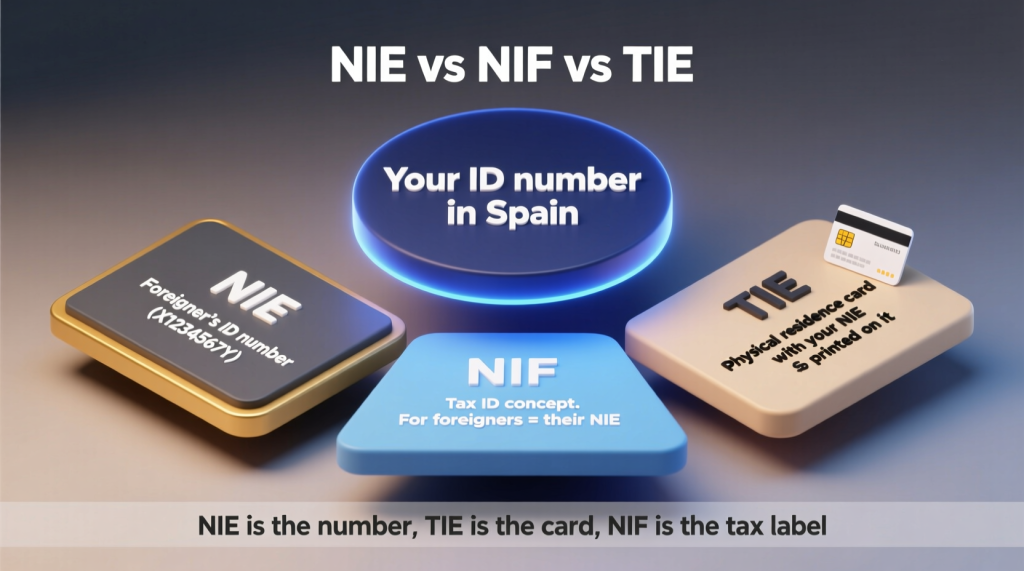
This is where most confusion arises. Let’s clear it up.
- NIE (Número de Identidad de Extranjero): This is the number itself. A sequence like X-1234567-Y. It’s your fiscal ID.
- NIF (Número de Identificación Fiscal): This is the Spanish Tax ID concept. For Spanish citizens, their NIF is their DNI (national ID) number. For foreign individuals, the NIE is their NIF. They are functionally the same for you. When a form asks for your NIF, you put your NIE.
- TIE (Tarjeta de Identidad de Extranjero): This is the physical plastic card that proves your right to reside and work in Spain. It looks like an ID card, has your photo, and crucially, it displays your NIE number on it. Not all foreigners get a TIE (e.g., short-term non-residents), but all TIE cards have an NIE.
A simple analogy: Your NIE is your social security number (the identifier). Your TIE is your driver’s license (the physical card proving a right). Your NIF is the term the taxman uses for both.
Who Needs a NIE and the Two Main Types
The requirement cuts across all nationalities. If you’re not Spanish and are engaging in the activities listed above, you need one. However, the application process and the “type” of NIE differ.
Typically, we distinguish between:
- NIE for Non-Residents (Certificado de NIE): This is for individuals who need to conduct specific transactions in Spain but do not (yet) establish legal residency. Think: buying property, inheriting assets, opening a non-resident bank account, or studying for less than 3 months. You apply with Form EX-15.
- NIE for Residents (Integrated into TIE): This is for individuals who intend to live in Spain for more than 90 days (non-EU) or 3 months (EU). Here, the NIE is assigned as part of your residency application (via a visa for non-EU, or the EU registration for EU citizens). The number is then printed on your TIE card (for non-EU) or your EU Registration Certificate (for EU).
The NIE Application Process: A Realistic Overview
Getting your NIE Spain is a rite of passage. The path depends on your location and goal.
- Applying from Outside Spain: You must apply at the Spanish Consulate in your country of legal residence. This is mandatory for non-EU citizens needing a visa. EU citizens can also do this to get things started early.
- Applying from Within Spain: You book the famous cita previa (appointment) online for the Police Immigration Office (Comisaría) or a dedicated Foreigners’ Office (Oficina de Extranjería).
The two most common forms are:
- Form EX-15: The standard “Application for a Foreigner Identity Number (NIE) and Certificate.” Used for non-resident NIEs or resident NIEs based on “economic, professional, or social interests.”
- Form EX-18: The “Application for a Foreigner Identity Card (TIE).” Used to get the actual residence card (which contains your NIE) once you are in Spain with a visa.
A Quick Comparison: NIE Pathways at a Glance
| Scenario | Typical Goal | Main Form | Applied At | Outcome |
|---|---|---|---|---|
| Buying property (non-resident) | Obtain tax ID for transaction | EX-15 | Consulate or Police in Spain | Certificado de NIE (Green Paper) |
| Starting a business/ freelance | Fiscal ID for tax & banking | EX-15 or via Residency | Consulate or Police in Spain | NIE Number / Certificate |
| Moving to live & work (EU citizen) | Register as an EU resident | EU-1 (varies) / EX-18 | Police Office in Spain | Certificado de Registro (with NIE) |
| Moving to live & work (Non-EU) | Obtain residence & work permit | Via Long-Term Visa (EX-00) | Consulate abroad, then Police in Spain | TIE Card (with NIE printed) |
Essential Tips for Your NIE Journey
Spanish bureaucracy has a reputation. Being prepared is half the battle.
- Documentation is King: Requirements shift. Always, always check the official website of the institution you’re applying to (Consulate or Police) for the latest checklist. Missing one paper means rejection.
- The Tasa Fee: You must pay the administrative fee (Modelo 790, código 012) at a Spanish bank before your appointment. Bring the stamped proof.
- Translation & Apostille: Official documents not in Spanish (birth certificates, marriage certificates) require a sworn translation. Some may also need an Apostille or legalization.
- Professional Help Can Save Time: For complex cases (business founders, investors, those with tight deadlines), using a reputable gestor or immigration lawyer is common. They navigate the system daily.
- Patience is a Virtue: Appointment slots are limited. Processing takes time. Build a buffer of several weeks, if not months, into your plans.
“The NIE is the first and most critical link between a foreign national and the Spanish state. It’s not just a number; it’s the prerequisite for legitimacy in the system,” notes an expert in Spanish administrative law.
Your First Step Towards Life in Spain
Understanding what is NIE Spain is the first step in your Spanish adventure. It’s the cornerstone of your financial and legal identity here. Whether you’re drawn by the sun, the business opportunities, or the lifestyle, securing your Número de Identidad de Extranjero is the practical task that makes the dream possible. Gather your documents carefully, choose the right path for your situation, and take this essential step with confidence.
FAQ
1. What does NIE stand for in Spain?
NIE stands for Número de Identidad de Extranjero, which translates to Foreigner Identity Number. It is a unique tax identification number issued by the Spanish government to non-Spanish nationals.
2. Is the NIE the same as a residence permit?
No. The NIE is a number, while a residence permit (often embodied in the TIE card) is a document granting the right to live in Spain. The NIE number is printed on residence permits, but you can have an NIE without a residence permit (e.g., as a non-resident property owner).
3. Can I apply for an NIE without going to Spain?
Yes, in most cases. You can apply for an NIE certificate through the Spanish Consulate in your home country or country of legal residence. This is often required for non-EU citizens and is a practical first step for EU citizens planning significant transactions.
4. How long is an NIE valid for?
The NIE number itself is permanent and lasts a lifetime. However, the certificate or card that displays it may have an expiry date tied to your residency status. For example, a non-resident NIE certificate doesn’t expire, but a TIE card for a temporary resident typically does.
5. What is the difference between the EX-15 and EX-18 forms?
Form EX-15 is used to apply for the NIE number and certificate itself, often for specific transactions or for initial registration (especially for EU citizens). Form EX-18 is used to apply for or renew the physical Foreigner Identity Card (TIE), which is issued to non-EU residents and contains the NIE.
6. Do EU citizens need an NIE?
Yes. While EU citizens have the right to live and work in Spain, they still require an NIE number to perform almost any official act, such as working for a Spanish employer, signing a rental contract, or opening a bank account. They obtain it by registering as an EU resident.
7. How long does it take to get an NIE?
Processing times vary significantly. At a consulate abroad, it can take several weeks. In Spain, after securing a hard-to-get appointment, the certificate can sometimes be issued on the spot or within a few days. Always plan well ahead for any life or business move requiring an NIE.