
Can I Get an NIE Number Without Residency in Spain? The Complete Non-Resident Guide
19 December 2025
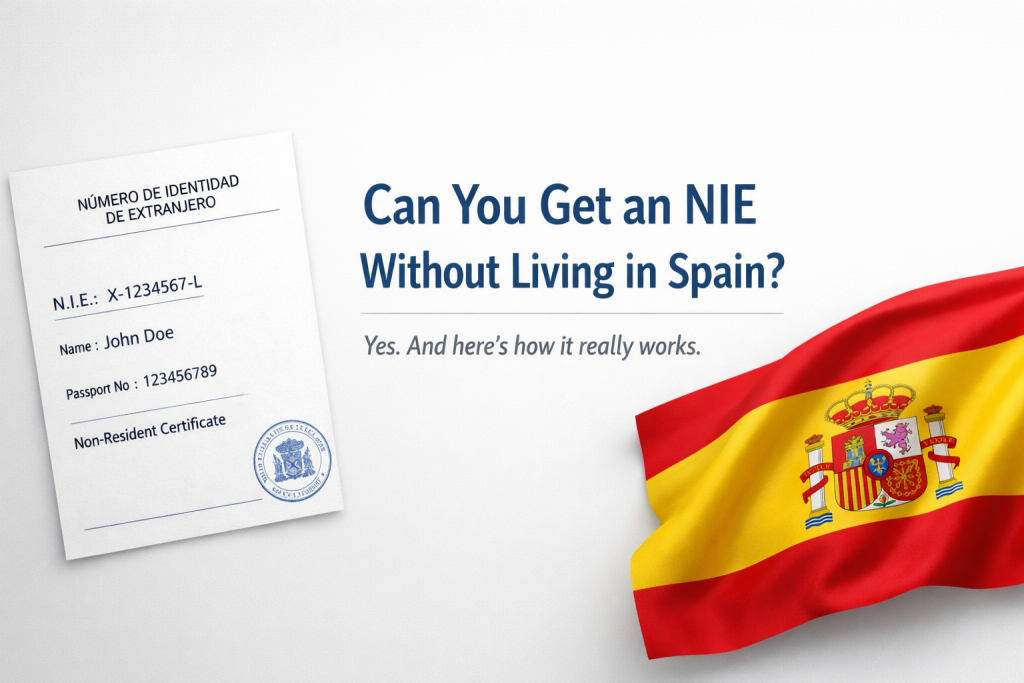
Here’s the short answer: yes, you can absolutely get an NIE number without being a Spanish resident. We see this confusion all the time, and it’s totally understandable. Your NIE (Número de Identidad de Extranjero) is simply your tax identification number in Spain—it’s not a residency permit.
Thousands of people need it for buying property, opening bank accounts, or signing job contracts long before they actually move to Spain. Maybe you’re investing in a Barcelona apartment from overseas, or you’ve landed a remote job with a Spanish company and need to get paid legally. Perhaps you’re inheriting property in Andalusia or starting a freelance business that requires Spanish registration.
The process itself is technically straightforward—fill out forms, gather documents, book appointments. But here’s the reality: doing it yourself often means weeks of back-and-forth with bureaucracy, confusing government websites that crash, appointments that vanish the moment they appear, and forms rejected for tiny errors you didn’t know mattered. Whether you’re applying from your home country through a consulate or already visiting Spain on a tourist visa, getting a non-resident NIE requires patience, persistence, and often a fair bit of Spanish language skills.
Let’s walk through everything you need to know, including the common headaches people face and what actually works.
What Is a Non-Resident NIE?
Think of your NIE as your Spanish ID number for all administrative purposes. It follows a simple format: one letter, seven digits, and another letter (like X-1234567-L). Once you get it, that number is yours forever. No renewals, no expiration dates, no hassle.
The key thing to understand? Having an NIE doesn’t make you a Spanish resident. It’s just an identifier the Spanish government uses to track your transactions, taxes, and legal activities in the country. You might need it to buy an apartment in Barcelona, set up a business in Madrid, accept a job offer before your big move, or even just to register a car you’re importing.
Your NIE never expires. That same number stays with you whether you’re a tourist buying property, a digital nomad working remotely, or eventually a full Spanish resident. The document you receive as a non-resident is a simple white paper certificate—not fancy, but it gets the job done for all legal purposes.
If you later become a resident, you’ll get a plastic TIE card with your photo, but the NIE number itself? Stays exactly the same. We’ve had clients use the same NIE for decades—from their first property purchase as investors to eventually retiring in Spain full-time.
The Spanish bureaucracy requires this number for virtually everything financial or legal. Banks won’t open accounts without it. Notaries won’t process property sales. Employers can’t put you on payroll. Tax authorities need it to track your obligations. It’s the foundation of your entire administrative life in Spain, even if you never actually live there.
Resident vs. Non-Resident NIE: What’s the Difference?
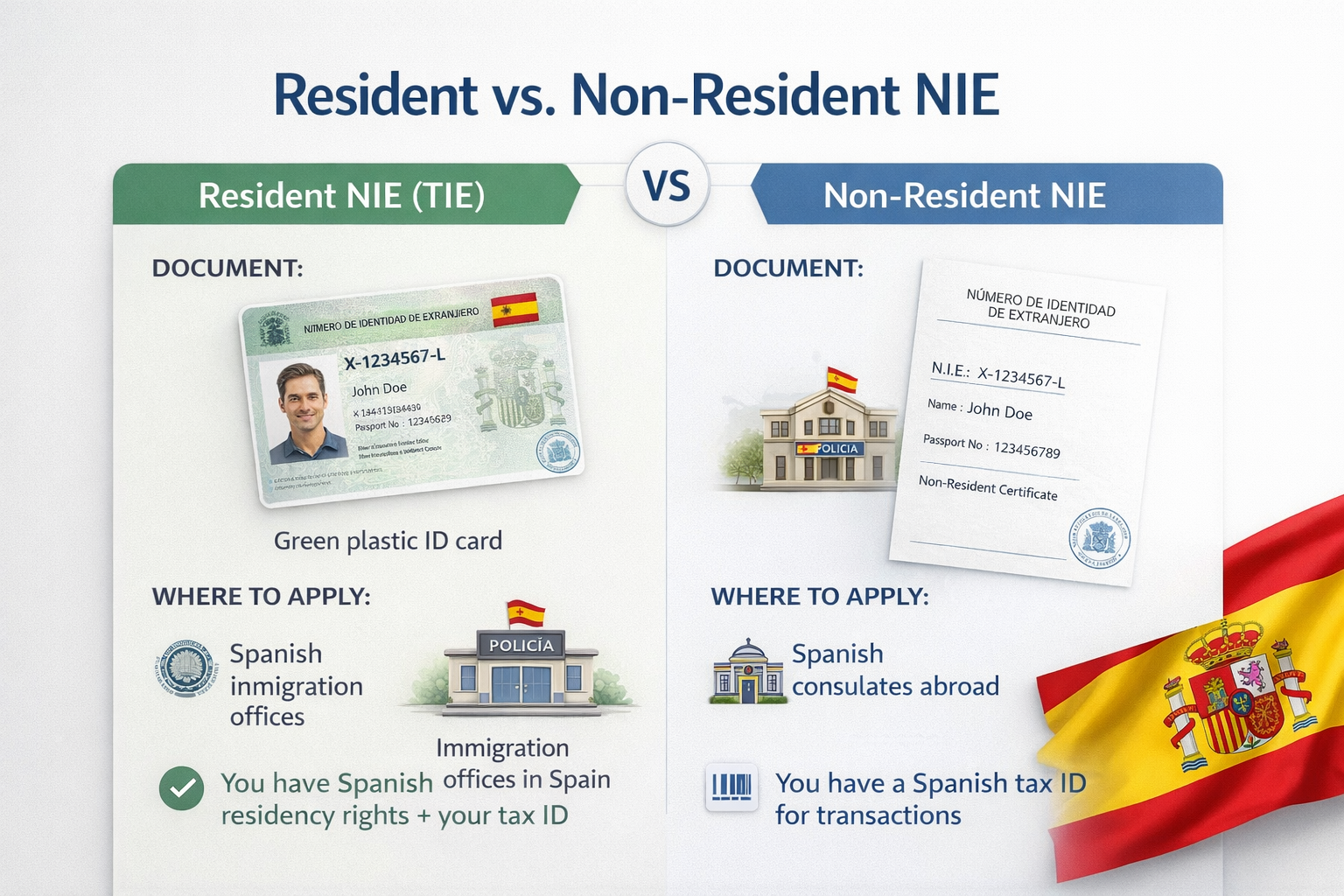
This trips up a lot of people, so let’s clear it up. There are two different documents, but only one NIE number. The confusion usually starts because people use «NIE» to refer to both the number and the documents—and Spanish officials aren’t always great at explaining the distinction.
| Type | Document Format | Who It’s For | Where to Apply | What It Proves |
|---|---|---|---|---|
| Non-Resident NIE | White paper certificate (A4 size) | Anyone needing to do transactions in Spain without living there | Spanish consulates abroad or police stations in Spain | You have a Spanish tax ID for transactions |
| Resident NIE (TIE) | Green plastic card with photo | People living in Spain with residency rights | Immigration offices in Spain after residency approval | You have legal residency status + your tax ID |
When you first apply for a non-resident NIE, you get that paper certificate. It looks pretty basic—just official letterhead with your NIE number, name, passport number, and an official stamp. Don’t lose it, though. While you can request duplicates, it’s easier to just keep the original safe.
If your plans change and you move to Spain permanently, you don’t lose your NIE number. You just upgrade to the TIE card with the same exact number printed on it. The Spanish system is actually pretty logical here—they assign you one number and stick with it. No need to update anything with banks, property registries, or tax authorities when you transition from non-resident to resident.
We’ve seen Reddit threads where people stress about this—they think they need to «get their NIE again» when becoming residents. Nope. Same number, different document. That’s it. The TIE application process references your existing NIE, and the immigration office simply issues you a card with that number already on it.
How to Apply for NIE from Abroad (And Why It Takes Forever)
Planning ahead? Smart move. Applying through your local Spanish consulate is usually the cleanest route if you haven’t arrived in Spain yet. This approach works well if you’re still months away from any Spain travel, or if you need the NIE to finalize documents before even booking your flight.
But here’s what nobody tells you upfront: consulate applications can drag on for months between appointment availability, processing time, and various bureaucratic delays.
Step 1: Find Your Local Spanish Consulate
Your application goes through the Spanish embassy or consulate in your country of residence. Each consulate runs things completely differently—there’s no standardized system. The New York consulate operates differently than London, which differs from Sydney or Singapore. What worked for your friend in one city might not apply to yours.
If you’re between countries or living abroad temporarily, contact the consulate where you have legal residence. They’ll want proof you’re in their jurisdiction before accepting your application. No jurisdiction proof? Your application gets rejected before it even starts.
Step 2: Book an Appointment (Good Luck)
Most consulates require you to schedule ahead. Some use online booking systems that theoretically let you see available slots and book instantly—except the systems are often outdated, crash frequently, and show phantom appointments that disappear when you try to select them.
Others want you to call during specific hours (often in the middle of your workday if you’re in a different time zone) or send an email and wait days or weeks for them to offer you times. Don’t expect to walk in—these appointments can book up 6-8 weeks in advance, especially in major cities.
During peak seasons (spring and summer when people buy vacation properties), availability gets even tighter. We’ve seen cases where people couldn’t get consulate appointments for three months because they waited until the last minute. If you have a property closing deadline or job start date, this timeline can torpedo your plans.
Step 3: Gather Your Documents (And Pray You Got Everything Right)
Here’s what you’ll typically need for your consulate appointment:
-
Valid passport (bring the original plus a photocopy of the data page with your photo and details—some consulates want copies of ALL pages, even blank ones)
-
Completed EX-15 form (this is the official NIE application form where you explain why you need the number—download it from the consulate website, if it’s working that day)
-
Proof of your reason (property purchase contract, job offer letter, business registration documents, bank letter stating you need an NIE to open an account)
-
Two recent passport-style photos (same specs as passport photos—but check if YOUR consulate wants 35mm or 40mm, white background or light-colored, matte or glossy)
-
Form 790 Code 012 (the fee payment form, usually around €9.84-€12 depending on the year—some consulates collect payment at the appointment, others want it paid beforehand at specific banks)
-
Proof you live in that consulate’s jurisdiction (utility bill, rental agreement, driver’s license—must be recent, usually within 3 months)
The «reason» field on your EX-15 matters more than you’d think. Be specific and honest. «Economic interests» works if you’re buying property—attach the preliminary sales contract. «Professional interests» fits for job contracts—include the signed offer letter. «Social interests» might work for family connections, but it’s vaguer and raises more questions.
Here’s where people mess up constantly: vague reasons like «I might need it someday» or «planning to look for opportunities in Spain» get rejected immediately. Spanish authorities want concrete justification backed by official documents. We’ve seen applications rejected because someone wrote «business purposes» without attaching incorporation documents, or «banking» without a letter from the actual bank.
The more documentation you provide proving your stated reason, the smoother your application goes. But too many documents? Also a problem—consulates have been known to reject «messy» applications with excessive paperwork.
Step 4: Attend Your Appointment (If It Actually Happens)
You need to show up in person—no mailing it in. The consular officer will review your documents, collect your fee, and submit your application to Spain. They might ask questions about your plans or request additional clarification on your documentation.
Dress business casual. Be polite and patient. Consular staff are often dealing with dozens of applications daily, and attitude matters. If they spot an issue with your paperwork, they’ll usually explain what’s missing and let you resubmit once it’s fixed—which means scheduling another appointment weeks out.
Here’s the kicker: some consulates have been known to cancel appointments last-minute with minimal notice. You’ve cleared your schedule, maybe taken time off work, driven hours to the consulate, and then you get an email the day before saying your appointment is cancelled. Reschedule? Back to step 2, fighting for another slot weeks away.
Step 5: Wait for Processing and Collection (The Long Game)
Timeline varies wildly by consulate. Some issue your NIE certificate in two weeks. Others take two months. Processing times depend heavily on which consulate you’re dealing with and how backed up they are.
Most consulates notify you by email when your NIE is ready for pickup—if you’re lucky. Some don’t notify at all, requiring you to follow up repeatedly. You’ll need to collect it in person during specific collection hours (usually different from appointment hours, naturally) or authorize someone with power of attorney to collect on your behalf.
They typically won’t mail original documents internationally due to security concerns. If you’ve moved or traveled since your appointment, tough luck—you’ll need to arrange collection somehow.
One important heads-up: We’ve seen Reddit users report that some consulates push back if they suspect you’ll be working in Spain without proper work authorization. If you’re applying based on a job offer, make sure your visa situation is crystal clear. EU citizens don’t face this issue, but non-EU applicants need to demonstrate they have the right to work or that they’re applying for the appropriate visa.
Frame your reason carefully and make sure you’re legally allowed to do whatever you’re claiming you need the NIE for. Don’t say «I’m starting a job» if you don’t have work authorization yet. Instead, say «I’m applying for a work visa and need the NIE to complete the employment contract required for my visa application.» Get the wording wrong? Rejection and starting over.
Getting NIE Inside Spain as a Non-Resident (Faster But Not Easier)
Already in Spain on a tourist visa? You can apply directly at immigration offices (Oficina de Extranjeros) or national police stations (Policía Nacional) that handle foreigner documentation. This route often makes sense if you’re already visiting Spain for other reasons or if you need your NIE quickly.
The process is similar to consulate applications but often faster—when you can actually get through the appointment system.
The Appointment Nightmare
Book your appointment through the Spanish Ministry of Interior’s online system. This is where things get truly frustrating:
-
The website only works properly in certain browsers (usually Internet Explorer or older Firefox versions)
-
It crashes regularly, especially around 9 AM when everyone’s trying to book
-
Appointments fill up within minutes—sometimes seconds—of being released
-
The system releases appointments in unpredictable batches, sometimes at 2 AM, sometimes noon, with no pattern
-
Forms time out if you take more than 15 minutes, losing all your data
-
Error messages are in Spanish with no translation
-
The captcha system fails constantly, locking you out
Reddit is full of stories about people refreshing the appointment portal every hour for weeks trying to snag a slot in Barcelona or Madrid. Some people set alarms to check at midnight or 6 AM when new slots might appear. Others hire services that monitor the system automatically and grab appointments the moment they appear.
In major cities, you might wait 4-8 weeks just to get an appointment. Miss your appointment? Back to square one, fighting for another slot.
The Actual Appointment
Once you finally have an appointment:
-
Bring the same documents listed above—passport, EX-15 form, proof of reason, photos, fee payment form. The requirements don’t change based on location, but which documents they actually care about does vary by office.
-
Show proof of legal entry if you’re non-EU (your entry stamp, visa, landing card proving you entered Spain legally and are within your allowed stay period).
-
Processing is quicker: Some offices hand you the certificate same-day if everything is in order. Others take 5-10 business days and ask you to return for pickup.
But here’s what goes wrong frequently:
-
Officers reject applications for tiny formatting errors (wrong photo size, form filled in blue ink instead of black, copies not properly certified)
-
Different offices interpret requirements differently—what worked in Málaga might get rejected in Valencia
-
Spanish language skills matter—if you can’t explain your situation, officers might refuse your application
-
Some offices are notorious for finding reasons to reject applications, requiring you to book another appointment and try again
Smaller cities tend to have better appointment availability. If you’re flexible about location, consider applying in nearby towns rather than major tourist hubs. Your NIE is valid nationwide—doesn’t matter if you get it issued in a tiny town or the capital.
But that means traveling to that smaller town, possibly multiple times, and coordinating around their specific office hours.
Common Scenarios for Non-Resident NIE
Why would you need a non-resident NIE in the first place? Here are the situations we see most often:
-
Buying Spanish property as an investment (you can’t complete the purchase without an NIE—notaries won’t proceed, and sellers won’t wait indefinitely)
-
Opening a Spanish bank account for transactions, receiving rental income, or getting paid by Spanish clients
-
Signing an employment contract before you’ve secured your work visa or residency
-
Starting a business or registering as self-employed (autónomo) for freelance work with Spanish clients
-
Tax obligations like declaring rental income from a Spanish property you own but don’t live in
-
Inheritance matters or other legal proceedings involving Spanish assets (often with tight legal deadlines)
-
Setting up utilities in your name (water, electricity, internet providers often require NIE)
-
Buying or registering a vehicle in Spain
-
Getting a Spanish phone number (some carriers require NIE)
-
Applying for certain licenses or permits (like boat licenses if you’re keeping a yacht in Spain)
In many of these situations, timing matters critically. Property closings have fixed dates. Job offers expire. Legal deadlines are hard. The 2-3 month process of fighting for appointments and waiting for processing can derail your entire plan.
Costs and Processing Times (When Everything Goes Smoothly)
Let’s talk numbers. The Spanish government keeps NIE fees surprisingly affordable:
| What | Cost/Timeline |
|---|---|
| Application fee (Form 790 Code 012) | €9.84 — €12.00 |
| Processing time (from abroad via consulate) | 2-8 weeks (officially) / 2-3 months (realistically with appointment waits) |
| Processing time (in Spain at police station) | Same-day to 2 weeks (if you can get an appointment) |
| Time spent fighting appointment systems | 2-6 weeks of daily checking |
| Additional costs (if using lawyer/gestoría) | €150 — €400 depending on complexity and urgency |
| NIE validity period | Forever (never expires or needs renewal) |
The fee itself is refreshingly cheap compared to visa applications or residency permits. Your NIE has no expiration date—once issued, it’s valid for life.
But here’s what the official costs don’t show: the hidden expenses of doing it yourself. Time off work for consulate appointments. Potentially multiple trips if documents are rejected. Stress and frustration dealing with incomprehensible government websites. Missing deadlines because appointments weren’t available in time.
Many people hire a lawyer or gestoría (administrative management firm) to handle the NIE application, especially for property purchases where the gestoría is already managing the transaction. This adds cost but saves massive hassle, particularly if you don’t speak Spanish or can’t easily travel for appointments. The gestoría handles all paperwork, knows exactly what each office wants, has relationships with officials, and can often expedite processing.
FAQ
Can I get a NIE without a job offer or property purchase?
Yes, but you need to provide a valid economic, professional, or social reason. «Planning to look for work» usually doesn’t cut it. «I need a bank account to receive payments from freelance clients» works better. Having concrete documentation—even a letter from a potential landlord stating they’ll rent to you once you have NIE, or a bank letter confirming they require NIE to open your account—strengthens your application significantly. But getting that documentation without already having the NIE? That’s the catch-22 many people face.
Do I need a Spanish address to get a non-resident NIE?
Not necessarily. Many people use a hotel address or their lawyer’s office address for the application. For consulate applications abroad, you won’t need a Spanish address at all—just proof you live in that consulate’s territory. The NIE certificate itself doesn’t list your address, just your name and passport details. But some police stations in Spain have started requiring proof of Spanish address, creating confusion since that’s not an official requirement for non-residents.
Can someone apply on my behalf?
Yes, with a legal power of attorney (poder notarial). This is common for property buyers who can’t travel to Spain for the appointment. Your representative submits everything for you at the police station or consulate, and you receive your NIE certificate.
The power of attorney must specifically authorize the person to apply for NIE on your behalf—generic powers of attorney might not work. And it needs to be properly notarized and sometimes apostilled, depending on the country. Getting a proper power of attorney prepared? That’s another process that can take weeks and cost €100-300.
Will my NIE expire or need renewal?
No. Once assigned, your NIE number is yours for life. Even if you never end up moving to Spain or you leave and never return, that number remains in the system permanently. There are no renewal requirements, no fees to maintain it, nothing. Get it once, have it forever. This is literally the only simple part of the process.
What’s the difference between NIE and TIE?
Your NIE is the number itself—the unique identifier. TIE (Tarjeta de Identidad de Extranjero) is the physical card that residents carry as their ID. Non-residents get a paper certificate with their NIE. Residents get a plastic TIE card. Same NIE number, different formats. Think of it like this: the NIE is your account number, and the paper/card is just different ways to display that number.
Can I work in Spain with just a non-resident NIE?
Not automatically. The NIE itself doesn’t grant work authorization—it’s just an ID number. EU citizens can work freely with just their NIE. Non-EU citizens need a work visa or work permit in addition to the NIE. Some people confuse getting the NIE with permission to work, but they’re separate things. You need both: authorization to work (visa/permit) AND an NIE to actually execute contracts and get paid.
How long does this whole process really take if I do it myself?
Realistically? If you’re applying from abroad through a consulate, expect 2-4 months from starting to look for appointments until you have the NIE certificate in hand. If you’re in Spain and lucky with appointments, maybe 3-6 weeks. If you hit complications—rejected documents, missed appointments, consulate delays—it can stretch to 5-6 months. We’ve seen people trying to close on Spanish property who had to delay their closing twice because their NIE wasn’t ready in time.
There’s a Better Way
Look, getting your NIE without residency is absolutely possible on your own. Thousands of people do it every year. But «possible» doesn’t mean easy, fast, or stress-free.
Between navigating broken appointment systems, deciphering Spanish bureaucracy, getting documents rejected for obscure formatting issues, and waiting months for processing, the DIY route typically takes 2-4 months and requires significant time investment. If you’re on a deadline—property closing, job start date, legal proceeding—that timeline might not work.
We’ve spent years building relationships with Spanish consulates and immigration offices. We know exactly what each office requires, how to format documents properly, and how to navigate the appointment systems efficiently. Our team handles everything—paperwork preparation, appointment booking, submission, and follow-up—while you focus on your actual plans for Spain.
Most of our clients receive their NIE certificates in 2-4 weeks, not months. No fighting with appointment portals at 3 AM. No rejected applications over tiny errors. No stress about whether it’ll arrive before your deadline.
Ready to skip the hassle? Get your NIE the easy way—we’ll handle the bureaucracy while you handle everything else.
RECENT POSTS
What is NIE Spain? Demystifying the Número de Identidad de Extranjero
[
](/can-i-get-an-nie-number-without-residency-in-spain-the-complete-non-resident-guide/)