
The NIE (Número de Identidad de Extranjero) is Spain’s foreigner identification number. You’ll need it for nearly every legal transaction in the country, from opening a bank account to signing a rental contract. This guide walks you through the entire application process with practical tips based on real experiences.
Need professional help? Get NIE number assistance here.
What Is an NIE Number and Why Do You Need It?
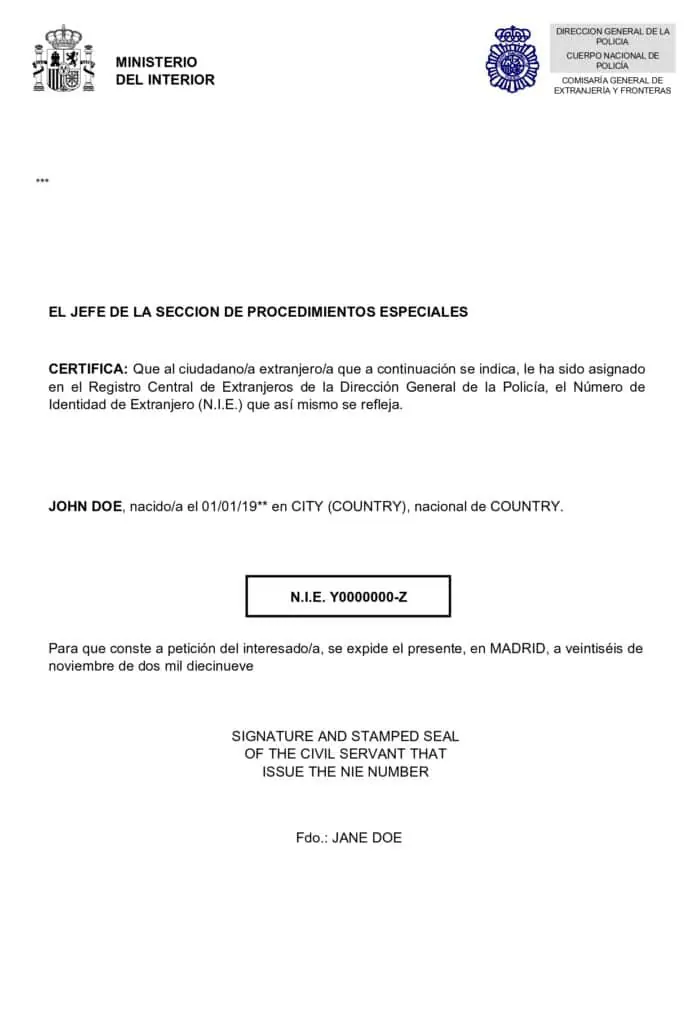
An NIE is a unique identification number assigned to non-Spanish citizens by the Spanish authorities. Think of it as your tax identification number and legal identifier rolled into one.
The NIE format consists of a letter (X, Y, or Z), followed by seven digits, and ending with a check letter—for example, Y-3688609-S. This number stays with you for life and never changes, regardless of your residence status in Spain.
You cannot function legally in Spain without an NIE. Here’s when you absolutely need one:
- Buying or selling property
- Opening a bank account (most Spanish banks require it)
- Starting employment or registering as self-employed (autónomo)
- Signing rental contracts
- Purchasing a vehicle or obtaining a driver’s license
- Setting up utilities (electricity, water, internet)
- Paying taxes or receiving government services
- Enrolling in Spanish social security
- Obtaining a Digital Certificate (FNMT) for online government services
- Enrolling children in public schools
- Accessing Spanish healthcare as a resident
Even if you’re just staying temporarily, many landlords and employers won’t proceed without seeing your NIE. Some transactions technically don’t require an NIE, but Spanish bureaucracy defaults to requesting it—so getting one early eliminates countless headaches.
What Are the Different Types of NIE in Spain?
Spain issues different NIE documents depending on your residency status. Understanding these distinctions prevents confusion and helps you apply for the correct document.
What Is a White NIE Certificate?
The White NIE is a simple A4 paper certificate containing your NIE number. It’s issued to non-residents conducting specific transactions like property purchases or investments, and to anyone needing an NIE before establishing residency.
What it gives you: Just the identification number itself
What it doesn’t give you: Residency rights, healthcare access, or proof of legal residence
You apply for a White NIE using form EX-15 at police stations or Spanish consulates.
What Is the Green NIE for EU Citizens?
The Green NIE is actually called the EU Registration Certificate (Certificado de Registro de Ciudadano de la Unión). It comes as either a green A4 document or a small laminated green card.
Who gets it: EU/EEA citizens registering as residents in Spain for stays exceeding 3 months
What it includes: Your NIE number plus proof of residency status
Requirements for EU citizens:
- Employment with a Spanish employer, or
- Self-employment with registered business activity, or
- Sufficient financial means (approximately €7,000 in Spanish bank account), or
- Private health insurance plus proof of funds, or
- Enrollment in recognized educational institution
You apply using form EX-18 (not EX-15).
What Is a TIE Card?
The TIE (Tarjeta de Identidad de Extranjero) is a physical biometric card for non-EU citizens with residence permits. It includes your NIE number, photo, fingerprints, and residence authorization details.
| Feature | White NIE | Green NIE | TIE Card |
|---|---|---|---|
| Document format | White A4 paper | Green card/A4 paper | Biometric card |
| Includes NIE number | ✓ | ✓ | ✓ |
| Proves residency | ✗ | ✓ | ✓ |
| Who can apply | Anyone | EU/EEA citizens only | Non-EU residents |
| Application form | EX-15 | EX-18 | Varies by visa type |
Most people start with the White NIE, then upgrade to Green NIE or TIE once they establish residency.
Where Can You Apply for Your NIE Number?
You can apply in Spain, at consulates abroad, or through professional services. The best option depends on your location and timeline.
How to Apply from Within Spain?
You must book an appointment (cita previa) at your local National Police station—either an Oficina de Extranjería (Immigration Office) or Comisaría de Policía (Police Station).
The official booking website: sede.policia.gob.es
Each Spanish province manages its own appointment system. You’ll need to select your province, choose «Asignación de NIE» (NIE assignment), enter personal details, and select an available appointment slot.
Pro tip: You can book appointments in neighboring towns or provinces if your local office has no availability. Your NIE isn’t tied to a specific location—you can apply anywhere in Spain.
Can You Apply from Outside Spain?
Yes. Apply through the Spanish consulate or embassy in your country of residence. Each consulate operates independently with different procedures, waiting times, and requirements.
Contact them directly to verify appointment booking process, specific document requirements, processing timeline (typically 2-6 weeks), and whether they accept courier submissions after video verification.
The General Commissariat of Foreigners and Borders processes all consulate applications, adding extra processing time compared to in-country applications.
Should You Use Professional NIE Services?
Services handle the entire process via Power of Attorney. This option works well if you don’t speak Spanish, can’t travel to Spain for appointments, want to avoid appointment-hunting frustration, or need faster processing.
Get Professional NIE Assistance →
How Do You Book an NIE Appointment in Spain?
Getting an appointment in major Spanish cities feels like winning a lottery. Slots disappear within seconds. Here’s how experienced expats secure appointments.
When Should You Check for Appointments?
Monday mornings at 8:00 AM sharp are prime time. Log in to the appointment system exactly at 8:00 AM and refresh repeatedly every 2-5 minutes between 8:00-9:00 AM. Many new slots open during this window.
After midnight (12:00 AM — 2:00 AM) captures late cancellations. People cancel appointments throughout the day, but these slots reappear in the system during overnight processing.
Alternative locations: If Barcelona has no appointments, check nearby towns like Mataró, Sabadell, or Granollers. You’re legally allowed to apply anywhere in your province or neighboring provinces.
What Do You Need for Booking?
- Valid passport or ID number
- Spanish phone number (essential for confirmation)
- Email address
- Proof of legal entry to Spain (passport stamp or boarding pass)
Important: The confirmation SMS arrives in Spanish. It contains your appointment reference number (localizador), date, time, and location. Save this message—you’ll need it for your appointment.
What If You Can’t Get an Appointment?
Hire a gestor or legal service: They monitor the booking system continuously with automated tools and grab cancelled slots immediately. This costs €50-150 but saves weeks of frustration.
Check smaller towns: Provincial capitals are overbooked. Smaller administrative centers often have same-week availability.
Be flexible: If you can only attend Fridays at 10 AM, you’ll wait much longer than someone checking all days and times.
What Documents Do You Need for NIE Application?
Missing documents cause most application rejections. Gather everything before your appointment.
What Are the Required Documents for Everyone?
1. Completed EX-15 form (two copies)
- Available from the official police website
- Must be in Spanish—no English version exists
- Do NOT sign it beforehand; police officers require signatures in their presence
2. Valid passport
- Original passport
- Complete photocopies of EVERY page—yes, even blank pages
- EU citizens can use national ID cards instead (copy both sides)
3. Modelo 790 payment receipt (form code 012)
- Costs €10.71
- Must be bank-stamped (proof of payment)
- Print all three pages of the form
4. Written justification for needing NIE
- Specific explanation of why you need the number
- Must correspond to supporting documents
- Generic reasons like «for living in Spain» get rejected
5. Proof of legal entry to Spain (if applying within Spain)
- Passport entry stamp
- Boarding pass from your arrival flight
- Valid visa if required for your nationality
What Additional Documents Do You Need Based on Your Purpose?
The documents you need vary depending on WHY you’re applying.
For property purchase:
- Signed sales contract (contrato de compraventa)
- Property reservation agreement
- Nota simple (property registry extract)
For employment:
- Official job offer letter with company details
- Employment contract (contrato de trabajo)
- Company registration documents
For business/self-employment:
- Business plan
- Proof of sufficient funds
- Professional qualifications or licenses
For studies:
- University or school acceptance letter
- Enrollment certificate
- Proof of tuition payment
For retirement or financial independence:
- Bank statements showing minimum €7,000 (for Green NIE)
- Pension award letter
- Investment portfolio statements
Important: All foreign documents require official translation to Spanish by a sworn translator (traductor jurado) and apostille certification for countries outside the EU.
How Do You Write a Good Justification Letter?
Your written justification is scrutinized more than people realize. Here’s what works:
Good example: «I require an NIE number to complete the purchase of residential property located at Calle Mayor 15, 2ºA, 28013 Madrid, as evidenced by the attached sales contract dated January 10, 2026.»
Bad example: «I need an NIE for personal reasons and to live in Spain.»
Be specific. Reference attached documents. State dates and locations. Show the officer you have legitimate administrative needs tied to concrete transactions.
How Do You Pay the Modelo 790 Fee?
Form 790 (Modelo 790, código 012) is Spain’s fee payment mechanism for NIE applications. Getting this wrong delays everything.
How Do You Fill Out Modelo 790?
Option 1: Fill online (requires Digital Certificate or Cl@ve)
Access the form through the Ministry website or National Police portal. The digital version auto-calculates fees and generates a barcode for payment.
Option 2: Manual completion
Download the PDF version and fill it by hand. You’ll need:
- Your full name exactly as it appears on your passport
- Your passport/ID number
- Your Spanish address (or address where you’re staying)
- Province where you’re applying
- Code 012 (for NIE assignment)
- Check the box marked «principal» in section 2
Critical detail: Name discrepancies between Modelo 790 and your passport cause immediate rejection. If your passport says «John Michael Smith,» your form must say exactly that—not «John M. Smith» or «John Smith.»
Where Can You Pay Modelo 790?
You must pay at a Spanish bank branch. The amount is €10.71 for standard NIE applications.
Banks that reliably accept Modelo 790:
- BBVA
- Bank Sabadell
- CaixaBank
- Santander
The process:
- Print all three pages of the form (essential—banks keep one copy)
- Take the form to any branch of the above banks
- Pay €10.71 in cash or by card (if you have an account)
- Request a stamp on at least one copy—ink stamp or printed stamp both work
- Keep the two stamped copies for your appointment
Common problems: Some banks only serve existing account holders. Try multiple branches or different banks. ATM payments don’t provide the required stamp. You must go to a teller.
What Is the Step-by-Step NIE Application Process?
Here’s the exact process when applying from within Spain.
Step 1: How Do You Complete the EX-15 Form?
Download form EX-15 from sede.policia.gob.es or any gestoría office.
Section-by-section guidance:
Personal information:
- Surname(s) first, then given name(s)
- Both parents’ surnames (Spanish tradition—just fill it out)
- Date and place of birth
- Nationality and gender
- Passport number
- Spanish address (where you’re staying or plan to live)
NIE field: Leave blank. The police assign your number.
Purpose section: This is critical. Select the checkbox that matches your justification:
- Economic interests (property, investment)
- Professional interests (employment, business)
- Social interests (studies, family)
Then write a specific explanation in the text box.
Important notes:
- Use CAPITAL letters for better legibility
- No signatures until you’re at the police station
- Bring two identical copies (one for them, one for you)
- Any corrections must be initialed
Step 2: When Do You Pay the Modelo 790 Fee?
Complete this BEFORE your appointment—officers won’t accept applications without the stamped payment receipt. Follow the payment process detailed in the previous section.
Step 3: How Do You Book Your Appointment?
Use the strategies outlined earlier in the «How Do You Book an NIE Appointment» section. You need this appointment to submit documents.
Step 4: What Happens at Your Appointment?
Arrive 10-15 minutes early. Spanish administrative offices are strict about timing. Late arrivals often forfeit their slot.
What happens at the appointment:
- Queue check-in: Show your appointment confirmation SMS/email
- Document review: Officer checks all paperwork
- Form completion: Sign the EX-15 forms in front of the officer
- Fingerprints: Taken if you’re applying for TIE (not for White NIE)
- Photo: Required for TIE applications only
- NIE issuance: Immediate in small towns, or pickup date given in large cities
Duration: 10-20 minutes if all documents are correct.
Officer questions you might face:
- «Why do you need this NIE?» (Answer matches your written justification)
- «Where will you live in Spain?» (Have your address ready)
- «How long are you staying?» (Be consistent with your documents)
Answers should be brief, clear, and match your paperwork exactly.
Step 5: When Do You Receive Your NIE Certificate?
Immediate issuance (same day): Common in smaller towns and provincial offices. You leave the appointment with your NIE certificate in hand.
Delayed issuance (3-10 business days): Standard in Madrid, Barcelona, and other major cities. The officer gives you a receipt (resguardo) with a collection date.
Return on the collection date with your passport (original) and the receipt they gave you. If someone else collects for you, they need notarized Power of Attorney plus their own ID.
How Do You Apply for NIE Through Consulates?
The consulate route is slower but more straightforward for people who can’t travel to Spain.
How Do You Find Your Consulate?
Spanish consulates serve specific geographic areas. You must apply through the consulate with jurisdiction over your legal residence, not just the nearest one. Check the Spanish Ministry of Foreign Affairs website (exteriores.gob.es) to confirm which consulate handles your area.
What Is the Consulate Application Process?
Step 1: Contact the consulate
- Email or call to request NIE application information
- Ask for their specific document list (varies by consulate)
- Inquire about appointment procedures
Step 2: Book appointment
Expect 2-8 weeks’ wait for appointments in busy consulates. Booking methods vary: online systems (US, UK, Australia), email requests (Asia, Africa, South America), or walk-in during specific hours (rare).
Step 3: Prepare documents
Standard requirements across most consulates:
- Completed EX-15 form (two copies)
- Valid passport (original + full photocopy)
- Modelo 790 payment (can often pay at consulate)
- Written justification with supporting evidence
- Two recent passport-sized photos
- Apostilled documents if from non-EU countries
- Official translations of any non-Spanish documents
Step 4: Attend consulate appointment
Bring all original documents plus copies. Consular staff review everything, may ask clarifying questions, and submit your application to Spain for processing.
Step 5: Wait for processing
Timeline: 2-6 weeks typically. The consulate sends your application to the General Commissariat of Foreigners and Borders in Spain. They assign your NIE and return the certificate to the consulate.
Step 6: Collect your NIE
The consulate notifies you via email or phone when ready. Collect in person with your passport. Some consulates mail certificates or allow courier pickup with authorization.
Which Consulates Process NIE Applications Fastest?
US consulates (New York, Los Angeles, Miami, Houston): Well-organized, appointment-based, usually 3-4 week processing.
UK consulates (London, Edinburgh, Manchester): Busy, longer appointment waits (6-8 weeks common), but reliable processing once submitted.
Asian consulates: Generally faster due to lower demand. Tokyo, Singapore, and Seoul process quickly (2-3 weeks common).
Latin American consulates: Highly variable. Some very efficient, others severely backlogged. Budget extra time.
How Long Does the NIE Application Take?
Total timeline from start to NIE in hand varies significantly based on your location and method.
What Are the Timeline Expectations by Method?
Applying in Spain (major cities):
- Appointment booking: 1-4 weeks
- Appointment to NIE issuance: 3-10 days
- Total: 2-6 weeks
Applying in Spain (small towns):
- Appointment booking: 3-7 days
- Appointment to NIE issuance: Same day
- Total: 1-2 weeks
Applying through consulates:
- Appointment booking: 2-8 weeks
- Processing after appointment: 2-6 weeks
- Total: 4-14 weeks
Using professional services:
- Document preparation: 2-3 days
- Power of Attorney processing: 3-5 days
- NIE issuance: 1-2 weeks
- Total: 2-4 weeks
What Causes NIE Application Delays?
Appointment scarcity: Barcelona, Madrid, Valencia, and Málaga see overwhelming demand. Appointments in these cities book out weeks ahead.
Peak seasons:
- June-August: Summer relocation season
- September: Academic year starts (student applications surge)
- January: New year relocations
- December: Holiday slowdowns
Document issues: Incomplete applications go to the back of the queue. Missing translations, unsigned forms, or expired passports add 2-4 weeks.
Administrative holidays: Spain observes numerous regional and national holidays when offices close completely.
How Much Does the NIE Application Cost?
Official fees are minimal, but total costs vary based on your approach.
What Are the Official Government Fees?
- Modelo 790 (código 012): €10.71
- Consular fees (if applicable): €15-30 depending on country
That’s literally it for the official charges.
What Additional Costs Should You Expect?
DIY approach:
- Translation services: €30-60 per document
- Apostille/legalization: €20-50 per document
- Travel to Spain (if abroad): €200-1,500
- Accommodation during NIE process: €30-150/night
- Notary services for justification documents: €50-100
- Total DIY cost: €150-500+
Using gestor (administrative assistant):
- Gestor fee: €50-150
- Document preparation: €30-80
- Plus official fees
- Total with gestor: €200-400
Full-service NIE company:
- Service package: €150-400
- Power of Attorney notarization: €50-100
- Plus official fees
- Total with service: €250-600
The premium for professional service seems high until you calculate lost vacation days, flight costs, hotel nights, and stress of navigating Spanish bureaucracy in a foreign language.
What Mistakes Should You Avoid When Applying for NIE?
These errors cause 90% of rejections.
What Are Common Document Mistakes?
Not copying every passport page: EU citizens need copies of both sides of their ID card. Non-EU citizens must copy EVERY passport page including blank pages with entry/exit stamps. Officers check this strictly.
Using expired documents: Passports must be valid throughout your NIE processing. If your passport expires in 3 months and processing takes 2 months, renew your passport first.
Missing translations: All non-Spanish documents need official sworn translation (traducción jurada). Google Translate printouts get rejected immediately.
No apostille on foreign documents: Documents from non-EU countries require apostille certification. Marriage certificates, birth certificates, and educational documents from the US, Canada, Australia, etc., need this.
What Are Common Form Completion Errors?
Signing forms at home: Police require signatures in their presence. Pre-signed forms may be rejected or require re-signing on the spot.
Wrong form version: Use the most recent EX-15 version. Outdated forms get rejected. Download fresh copies from the official website each time.
Inconsistent information: Name spelling must match across all documents exactly. «Jonathan» on passport but «John» on forms causes problems.
Wrong checkboxes: Selecting «residencia» instead of «asignación de NIE» sends you down the wrong procedure path entirely.
Leaving NIE field filled: The NIE number box should be empty. Don’t write your passport number or make up a number.
What Payment Mistakes Should You Avoid?
Name mismatch on Modelo 790: Payment form must show your name exactly as passport shows it. Discrepancies mean rejection and repayment.
ATM payment without stamp: Paying via ATM doesn’t provide the required bank stamp. You must pay at a teller window.
Expired payment receipt: Some provinces require Modelo 790 payment within 30 days of application. Very old receipts may be rejected.
Why Do Justification Letters Get Rejected?
Vague reasons: «I want to live in Spain» doesn’t work. You need specific, documentable reasons tied to transactions or circumstances.
Justification doesn’t match documents: If you write «property purchase» but attach employment documents, expect rejection.
No supporting evidence: Written justification alone isn’t enough. Every claim needs documentary proof.
What Should You Do After Receiving Your NIE?
Your NIE opens doors throughout Spain, but you need to leverage it correctly.
What Are the Immediate Next Steps?
Make multiple copies: Photocopy your NIE certificate extensively. Spanish institutions constantly request it. Keep copies in your wallet, at home, in cloud storage (photos), and with trusted family member.
Digital copies: Scan at high resolution. Photo with smartphone. Store in Google Drive, Dropbox, or email to yourself. You’ll need to send copies via email frequently.
Original safekeeping: Store the original certificate in a safe, fireproof location. Replacing lost NIE certificates involves bureaucracy you want to avoid.
How Do You Use Your NIE?
Opening bank accounts: Present NIE certificate, passport, and proof of address (rental contract or empadronamiento). Most banks process accounts same-day with valid NIE.
Registering residence (Empadronamiento): Visit your local town hall (ayuntamiento) with NIE, passport, and proof of residence. Empadronamiento is required for healthcare, voting, and many services.
Setting up utilities: Electricity, water, gas, and internet companies all require NIE. Some allow setup before NIE using passport, but will request NIE for final account registration.
Healthcare registration: EU citizens with Green NIE can register for public healthcare (tarjeta sanitaria) immediately. Non-EU residents need appropriate visas and social security registration.
Tax registration: Your NIE IS your Spanish tax identification number. Use it for all tax filings, declarations, and correspondence with Hacienda (tax authority).
When Will You Need to Show Your NIE?
You’ll use your NIE number constantly during your first year in Spain:
- Every bank transaction and account opening
- Signing any contract (rental, employment, mobile phone)
- Vehicle registration and driver’s license
- Property transactions
- Tax filings and declarations
- Social security registration
- Healthcare system enrollment
- University enrollment
- Opening business or becoming autónomo
- Applying for residence cards
- Getting Digital Certificate (FNMT)
- Court proceedings or legal matters
Memorize your NIE number. You’ll recite it as often as your phone number.
Which Spanish Regions Process NIE Applications Fastest?
Spain’s autonomous communities and provinces handle NIE procedures with varying efficiency.
How Fast Is NIE Processing in Madrid?
- Appointment availability: Very limited, 3-4 weeks typical wait
- Best police stations: Aluche office less crowded than central offices
- Processing speed: 5-7 days for certificate issuance
- Tips: Book Monday 8 AM or try Alcalá de Henares for better availability
How Fast Is NIE Processing in Barcelona?
- Appointment availability: Among worst in Spain, 4-6 weeks common
- Best alternatives: Mataró, Sabadell, Granollers have better slots
- Processing speed: 7-10 days
- Language: Officers may speak Catalan first; Spanish and English available
- Tips: Check appointment system after midnight for cancellations
How Fast Is NIE Processing in Valencia?
- Appointment availability: Moderate, 2-3 weeks
- Processing speed: 3-5 days, often same-day in smaller offices
- Tips: Alicante and Castellón offices faster than Valencia city
How Fast Is NIE Processing in Málaga?
- Appointment availability: High demand due to expat population
- Processing speed: Fast once you get appointment (often same-day)
- English: More officers speak English than other regions
- Tips: Marbella, Estepona, Nerja have better availability than Málaga city
What About Rural Areas and Small Towns?
- Appointment availability: Excellent, often same-week
- Processing speed: Usually same-day issuance
- Challenges: May have limited hours (2-3 days per week in very small towns)
- Benefits: Less crowded, more personalized service, officers more patient
Frequently Asked Questions About NIE
Can I get an NIE as a tourist?
Yes, if you have legitimate justification like a property purchase, investment, or business transaction tied to Spain. Tourism alone isn’t sufficient—you need economic, professional, or social interests requiring the number.
Do I need an NIE to open a bank account in Spain?
Most Spanish banks require NIE for standard accounts. Some offer non-resident accounts using only passport, but these have limitations and higher fees. If you plan regular banking activity, get your NIE first.
Can someone else collect my NIE for me?
Only with official notarized Power of Attorney (poder notarial). Your representative must present this document plus their own ID when collecting. Most police stations accept this, but verify beforehand.
What if my NIE application gets rejected?
You can reapply immediately after fixing the issues. Rejection notices cite specific problems (missing documents, incorrect forms, insufficient justification). Address those issues and submit a new application. There’s no waiting period or penalty for reapplying.
Does my NIE number change if I move cities within Spain?
No. Your NIE is tied to you personally, not your location. It remains the same regardless of where you live in Spain or how many times you move. Only the addresses on derivative documents like TIE cards change.
How long is an NIE valid for?
The NIE number itself is valid for life and never expires. The paper certificate doesn’t expire either, though some institutions prefer recently issued certificates (within 3 months) for certain transactions. TIE cards expire based on residence permit type, but the NIE number on them stays constant.
Can I work in Spain with just an NIE?
No. NIE is an identification number, not work authorization. EU citizens can work freely after registering residence (Green NIE). Non-EU citizens need appropriate work visas alongside their NIE. The NIE is necessary but not sufficient for employment.
What’s the difference between NIE and TIE?
NIE is the identification number itself—a simple paper certificate. TIE is a physical biometric residence card that contains your NIE number plus your photo, fingerprints, and residence authorization. You upgrade from NIE to TIE when establishing long-term residence.
Do children need NIE numbers?
Yes, if they’re engaging in activities requiring identification: school enrollment, healthcare registration, property inheritance, or any legal proceedings. Parents apply on behalf of minor children using birth certificates and their own NIE/documentation.
Can I apply for NIE without being in Spain?
Yes, through Spanish consulates abroad. You can also use professional services that process applications via Power of Attorney without requiring your physical presence in Spain.
What happens if I never use my NIE after getting it?
Nothing negative. The NIE remains valid indefinitely. It doesn’t grant residence rights or create tax obligations by itself. You can obtain it, leave Spain, and return years later to use the same number.
Can I have multiple NIE numbers?
No. Each person receives one NIE number for life. If you lose your certificate and request a duplicate, you receive the same number. If authorities accidentally assign two numbers (rare), they consolidate them to one.
Do I need to renew my NIE annually?
No. The NIE number never requires renewal. Residence cards (TIE) that contain your NIE number require renewal based on permit duration, but the NIE itself is permanent.