
The Beckham Law
TL;DR
- The Beckham Law (art. 93 LIRPF) taxes employment income at a flat 24% up to €600,000 and 47% above, instead of progressive rates that reach similar levels much sooner.
- It lasts six years: the year you become resident plus the five following tax periods.
- Since the Startups Law (Ley 28/2022) you qualify after only 5 years of non-residence, and remote workers, digital nomad visa holders, company administrators and their families are eligible.
- You must opt in with Modelo 149 within 6 months of your Spanish Social Security registration — miss it and the regime is gone for good.
- It is not for everyone: no personal and family allowances, almost no deductions — modest salaries can pay more under Beckham.
Facts verified 10 August 2026 against the Agencia Tributaria, BOE and CJEU. This is not tax advice.
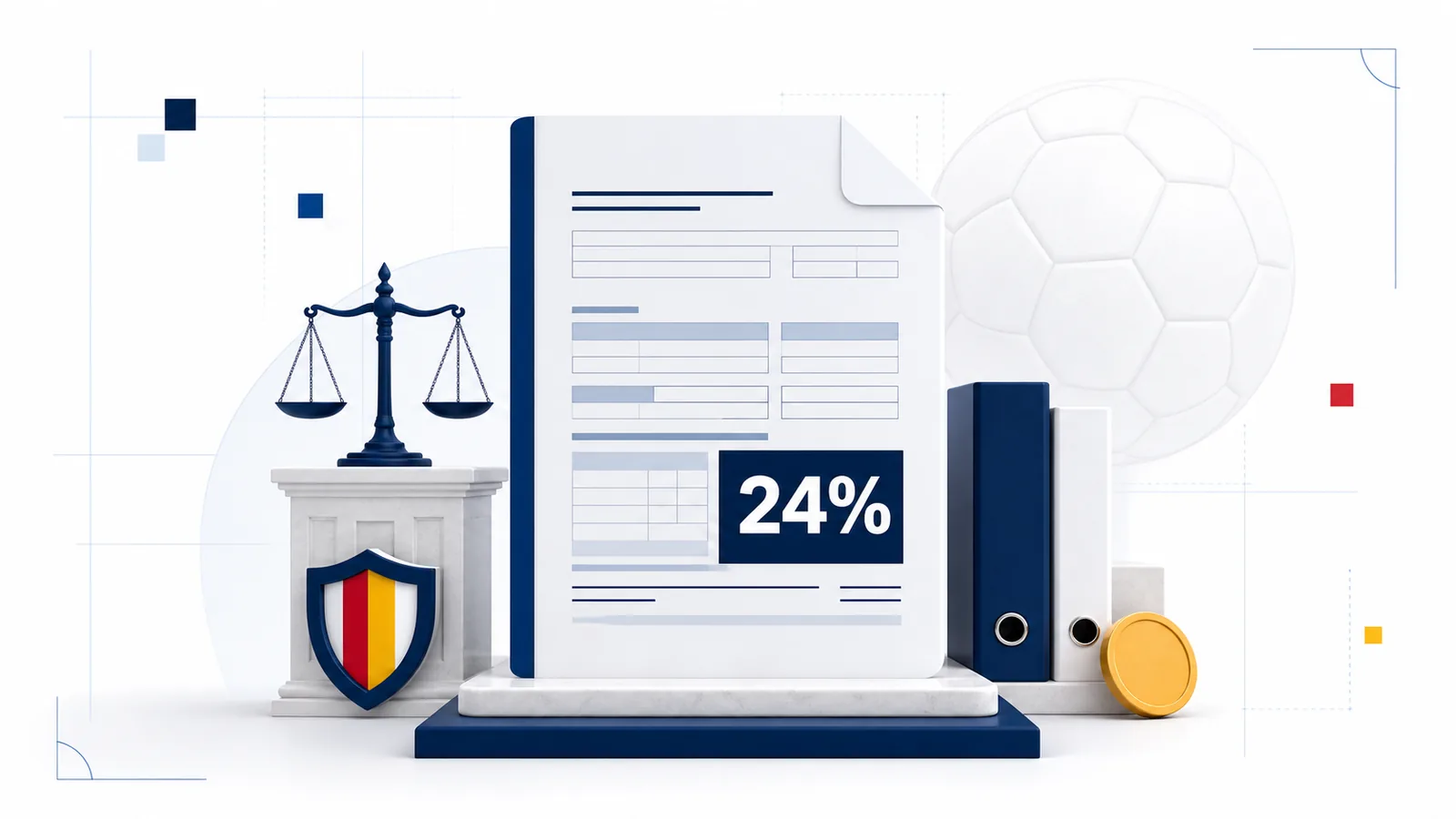
The régimen especial para trabajadores desplazados — universally the "Beckham Law", after its most famous early user — lets a newcomer live in Spain as a tax resident but be taxed, broadly, like a non-resident: a flat rate on employment income and no Spanish tax on most foreign income. It is the biggest legitimate lever in taxes in Spain for well-paid new arrivals, and since the Startups Law it covers far more people than footballers. It also has a brutal deadline — and a set of cases where it quietly costs more than the normal regime.
Updated 10 August 2026
Key facts
| Legal basis | Art. 93 LIRPF, amended by Ley 28/2022 (Startups Law) |
|---|---|
| Rate on employment income | 24% up to €600,000; 47% on the excess |
| Spanish savings income | 19%–30% progressive scale (top rate 30% since 2025, Ley 7/2024) |
| Duration | Year of arrival + 5 tax periods (six in total) |
| Prior non-residence | 5 years (was 10 before Ley 28/2022) |
| Opt-in | Modelo 149, within 6 months of Social Security registration |
| Annual return | Modelo 151 |
What the regime actually does
Under Beckham you are a Spanish tax resident on paper, but your tax base is built with non-resident rules: Spanish-source income plus all worldwide employment income. Employment income is taxed at a flat 24% up to €600,000, and at 47% only on the excess — however high the salary. Spanish-source savings income (dividends, interest, capital gains) uses the savings scale, which since 2025 runs from 19% to a top rate of 30% over €300,000 (Ley 7/2024 — many older articles still quote a lower top rate).
Foreign-source dividends, interest and capital gains are simply outside the Spanish net while the regime lasts — they are not "exempt", they are not taxed in Spain at all. The trade-off is treaty status: as a Beckham taxpayer you generally cannot rely on Spain’s double taxation conventions the way an ordinary resident can, so tax withheld abroad on that income often becomes a final cost.
Who qualifies after the Startups Law
Ley 28/2022 deliberately widened the gate from 1 January 2023. You must not have been a Spanish tax resident in the five tax years before the move (the law itself says the requirement "pasa de diez a cinco años"), the move must be triggered by a qualifying activity, and you must not earn income through a permanent establishment in Spain. Qualifying profiles:
- Employees posted to Spain or hired by a Spanish employer
- Remote workers employed by a foreign company who work from Spain using technology — including holders of the digital nomad visa (teletrabajo internacional)
- Company administrators, now regardless of their shareholding (except in asset-holding companies)
- Entrepreneurs with a qualifying business project, and highly qualified professionals working for startups or in R&D
- Family members: your spouse, children under 25 (any age with a disability), or the children’s other parent if you are not married — they can opt in with you
The six-month deadline that kills most applications
The option is exercised with Modelo 149 within a maximum of six months from the start date of your Spanish Social Security registration (alta) — not from your arrival, not from your visa, not from the tax year end. There is no extension and no second chance: file late and you fall into the general IRPF regime for the entire six-year window. This is the single most common way people lose the regime.
The clock usually starts earlier than people expect — the alta often happens on day one of the employment contract. Once admitted, you file an annual return on Modelo 151 instead of the ordinary resident return.
Because the deadline is unforgiving and the eligibility file (contract, alta, non-residence evidence) has to be right the first time, many applicants hand the paperwork to a specialist — Beckham Law application assistance handles the Modelo 149 option end to end.
When the Beckham Law is NOT worth it
The flat rate buys you out of the progressive scale — and out of almost everything that softens it. Under the regime there is no mínimo personal y familiar and no access to the general IRPF deductions: you keep only deductions for donations (donativos) and your withholdings on account, plus a capped deduction for foreign tax on overseas employment income. In practice:
- Modest salaries. Below roughly the level where general IRPF average rates cross 24%, the ordinary regime with its allowances is often cheaper — run both numbers before opting in.
- Families relying on allowances. Children, dependants and joint-taxation benefits count for nothing inside the regime.
- People who need treaty residence. If your income structure depends on Spain’s double taxation conventions, the regime’s weak treaty position can cost more than the flat rate saves.
Opting in also changes your reporting position on foreign assets — check how the regime interacts with Modelo 720 before assuming either way. And before any of this matters, check when you actually trip the residency wire in the first place — see becoming a tax resident.
⚠ Scams to avoid
- "Beckham for everyone" optimisers. Firms that push the regime on every new arrival, including modest earners who would pay less under general IRPF — the flat rate is a tool, not a universal discount.
- "Guaranteed approval" for late filers. Nobody can restore a missed Modelo 149 deadline; services claiming otherwise are charging for a doomed application.
- Retroactive residency engineering. Schemes that "adjust" your prior-year residence history to fake the 5-year non-residence condition are fraud, not planning.
FAQ
How long does the Beckham regime last?
Six tax periods: the year you acquire Spanish tax residence plus the five following years. It cannot be extended.
What is the deadline to apply?
Modelo 149 must be filed within six months of the start date shown on your Spanish Social Security registration (alta). Miss it and you cannot opt in later.
Are foreign dividends taxed under the Beckham Law?
No — foreign-source dividends, interest and capital gains fall outside Spanish tax while the regime applies. But you generally cannot claim treaty benefits as a Spanish resident, so foreign withholding tax may not be recoverable.
Can digital nomad visa holders use the Beckham Law?
Yes. Since Ley 28/2022, remote employees working from Spain for foreign companies — including international teleworking visa holders — are eligible.
Do I still file a Spanish tax return?
Yes — an annual return on Modelo 151, the regime’s own form, instead of the ordinary resident declaration.
Sources:
Agencia Tributaria — Manual IRPF, régimen fiscal especial aplicable a los trabajadores desplazados a territorio español, retrieved 10 August 2026; Ley 28/2022 (BOE-A-2022-21739); Ley 7/2024 (BOE-A-2024-26694); art. 93 Ley 35/2006 (LIRPF). This is not tax advice; whether the regime saves or costs you money depends on your numbers — model both regimes with a qualified adviser first.
Reviewed by the Happy Residence S.L. team. Every figure on this page is checked against the official source on the date shown above.
We are an administrative assistance service, not a public administration.